clustering.py
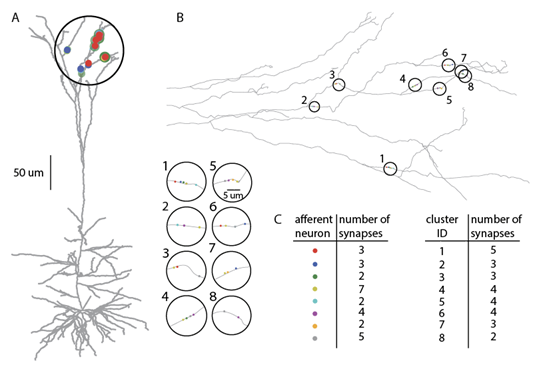
This script contains classes and functions for implementing synaptic clustering in the build step of the simulation.
- class L5NeuronSimulation.clustering.Cell(n_syns)[source]
A class used to an input cell within a functional group.
- n_syns
number of synapses from the cell
- Type
int
- syn_segs
list of Segments where the cell’s synapses should be placed
- Type
list
- num_set
number of synapses that the build step has already created. Functions as a way to iterate through synapses.
- Type
int
- class L5NeuronSimulation.clustering.Cluster(center, clustering_func, group_segs)[source]
A class used to represent a cluster of synapses within a functional group.
- center
the segment that the cluster is centered around
- Type
pd.Series
- n_syns
number of synapses attached to the cluster
- Type
int
- cluster_segs
contains the segments that are within the cluster
- Type
pd.DataFrame
- class L5NeuronSimulation.clustering.FunctionalGroup(seg_list, center, num_cells, num_clusters, name, start_id, grouping_func, clustering_func, syn_per_cell=[2, 8])[source]
A class used to represent a functional group of input cells. Each functional group has some number of clusters that it places its cells’ synapses into.
- center
the segment that the functional group is centered around
- Type
pd.Series
- n_cells
number of cells
- Type
int
- syn_per_cell
list of length two that contains the lower and upper boundary for the number of synapses from each cell. [low, high]
- Type
list
- n_clusters
number of clusters
- Type
int
- name
the name associated with the group. Used in the build step of the simulation for proper assignment.
- Type
str
- start_id
the node_id that is associated with the first cell in the cells list
- Type
int
- clustering_func
how segments are chosen for the clusters (formatted like make_seg_sphere above)
- Type
func
- group_segs
DataFrame of segments that fall within the group
- Type
pd.DataFrame
- cells
list of Cell objects that belong to the group
- Type
list
- clusters
list of Cluster objects that belong to the group
- Type
list
- class L5NeuronSimulation.clustering.Segment(bmtk_id, x)[source]
Simple class that represents a single segment in BMTK.
- bmtk_id
the id that BMTK associates with the section (not the section id)
- Type
int
- x
distance along the section
- Type
float
- L5NeuronSimulation.clustering.calc_dist(p1, p2)[source]
Returns the distance between two points.
- Parameters
p1 (list) – [x, y, z] representation of the first coordinate
p2 (list) – [x, y, z] representation of the second coordinate
- Returns
The distance between the two given points
- Return type
float
- L5NeuronSimulation.clustering.make_seg_sphere(segments, center, radius=50)[source]
Returns segments within a sphere of the given radius centered at the given center.
- Parameters
segments (pandas.DataFrame) – DataFrame with each row representing a segment that can be in the sphere
center (pandas.Series) – Series representing the segment that is the center of the created sphere
radius (int, optional) – The radius of sphere to be made in um (default is 50)
- Returns
DataFrame contiaining the subset of segments that is within the sphere
- Return type
pandas.DataFrame
- L5NeuronSimulation.clustering.plot_group(segs, group, ax, psoma=[0, 0, 0])[source]
Plots the given group’s center, cells, and clusters on the given plt axes.
- Parameters
segs (pd.DataFrame) – all segments that can possibly be plotted
group (FunctionalGroup) – the group to be plotted
ax (Axes3d) – what to plot on
psoma (list, optional) – used to shift the coordinates of the segments to match the morphology plot. formatted as [x, y, z] (default is [0, 0, 0])